
What Is the Difference Between Backend and Frontend Development?
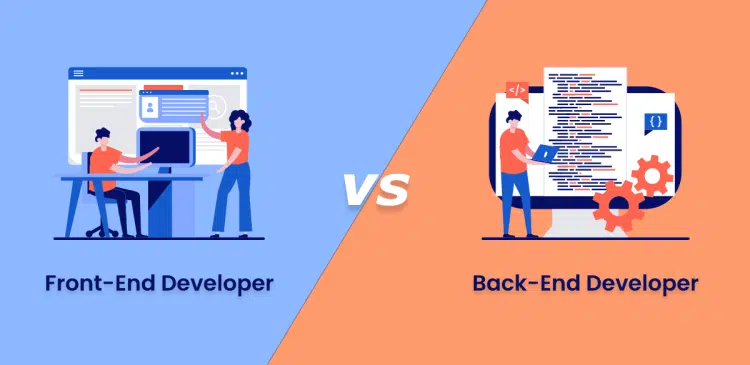
In today’s digital world, every website and application you use is built using two essential components: frontend and backend development. While both work together to deliver a seamless user experience, they serve very different purposes. Understanding the difference between backend and frontend development is crucial for anyone interested in web development, whether you’re a beginner, a business owner, or someone exploring a tech career.
What Is Frontend Development?
Frontend development is concerned with all the things that a user sees and corresponds with in an application or site. It has been called the client-side of development.
Frontend developers create and construct the visual part of a web site, layout, buttons, navigation menu, images and text. They aim at making the interface easy to operate, enjoyable and appealing.
Key Responsibilities of Frontend Developers
- Developing responsive designs that can be used across all gadgets.
- Enhancing user-friendliness (UX) and user interface (UI).
- Assuring the rapidity of loading and the ease of interaction.
- Adopting code-based design.

Common Frontend Technologies
Frontend programmers normally work with:
HTML – Structures the content
CSS – Styles the appearance and the layout.
JavaScript – Provides interactivity and dynamism.
They can also rely on such frameworks as React, Angular, or Vue to create modern and efficient interfaces.
What Is Backend Development?
The server side of an application is known as Backend development. It takes care of all the things which are not visible to the users but are imperative to the proper functioning of the site.
The backend handles databases, requests and makes sure that the data is moving in the correct directions in both directions between the front end and the server.
Key Responsibilities of Backend Developers
- Developing and sustaining server-side logic.
- Database and data storage management.
- Dealing with authentication and security.
- Receiving and sending back user requests.
Common Backend Technologies
Backend developers usually deal with:
- Such programming languages as Python, Java, PHP, Ruby, and Node.js.
- MySQL, PostgreSQL and MongoDB Databases.
- Apache and Nginx server technologies.
Core Differences Between Frontend and Backend Development
Frontend and backend development are closely related but they differ in some crucial aspects.
User Interaction vs. Server Logic
Frontend development is the one which is concerned with user interaction. It is all that you can see on a screen, buttons and animations.
Backend development on the other hand operates in the background. It manipulates information, executes logic and makes all things work.
Technologies Used
Frontend developers make use of HTML, CSS, and JavaScript, as well as frameworks which improve user interfaces.
The programming languages, databases and server technologies are used by the backend developers to handle application logic and data.
Focus Area
- Frontend is concerned with design, usability and user experience.
- Backend is concerned with performance, security and data management.
Performance Responsibilities
Frontend developers work to make the visuals and responsiveness optimized so that the user experiences are smooth.
The role of backend developers is to make sure that servers are fast, data processing is efficient, and systems are scaled accordingly.
How Frontend and Backend Work Together
Frontend and backend development are not independent of each other but they collaborate to form a full web application.
For example, when you fill out a login form:
- Your input (username and password) is obtained by the frontend.
- The information is forwarded to the backend server.
- The information is verified with a database by the backend.
- A reply is given back to the frontend.
- The result (success in the login or error message) is shown in the frontend.
This partnership also provides the users with a pleasant and user-friendly experience.
Which One Should You Learn?
Frontend or back-end development is a decision based on your interests and career objectives.
Choose Frontend Development If:
- If you like design and creativity.
- If you prefer working with images and designs.
- If you desire to have interactive user interfaces.
Choose Backend Development If:
- If you like solving problems and reasoning.
- If you prefer working with information and computers.
- If you are interested in system architecture, security.
If you’re unsure, you can also become a full-stack developer, which means you work on both frontend and backend.
Why Understanding the Difference Matters
Being aware of the distinction between the two, backend and frontend development, can be useful in the following ways:
Better collaboration: Teams are able to communicate better.
Improved project planning: You understand what goes into building a website
Career clarity: Assists you in making the right choice of development.
Business insights: Will allow making wiser decisions regarding hiring developers.
Key Takeaways
Frontend and backend development are two sides of the same coin. While frontend focuses on what users see and interact with, backend ensures everything works smoothly behind the scenes. Both are essential for building modern, functional, and user-friendly applications.
Whether you choose frontend, backend, or full-stack development, understanding their differences will give you a strong foundation in web development and help you grow in the tech industry.
 Bill Yeager, Co-Owner of High Point SEO & Marketing in CT


